
Forms Required For Reconsideration Requests
By SSDI Reconsideration Help Editorial Team | Reviewed for legal context by David McNickel
When you file for reconsideration, you’ll encounter several forms – some mandatory, some optional, some helpful even though they’re not required. Understanding which forms you need to complete, what each form does, and how to fill them out correctly will help you avoid delays and ensure your reconsideration gets off to a strong start.
The good news is that the core reconsideration filing process requires only one mandatory form. The complexity comes from the additional forms that may be necessary depending on your situation and the type of evidence you’re submitting.
Core Forms
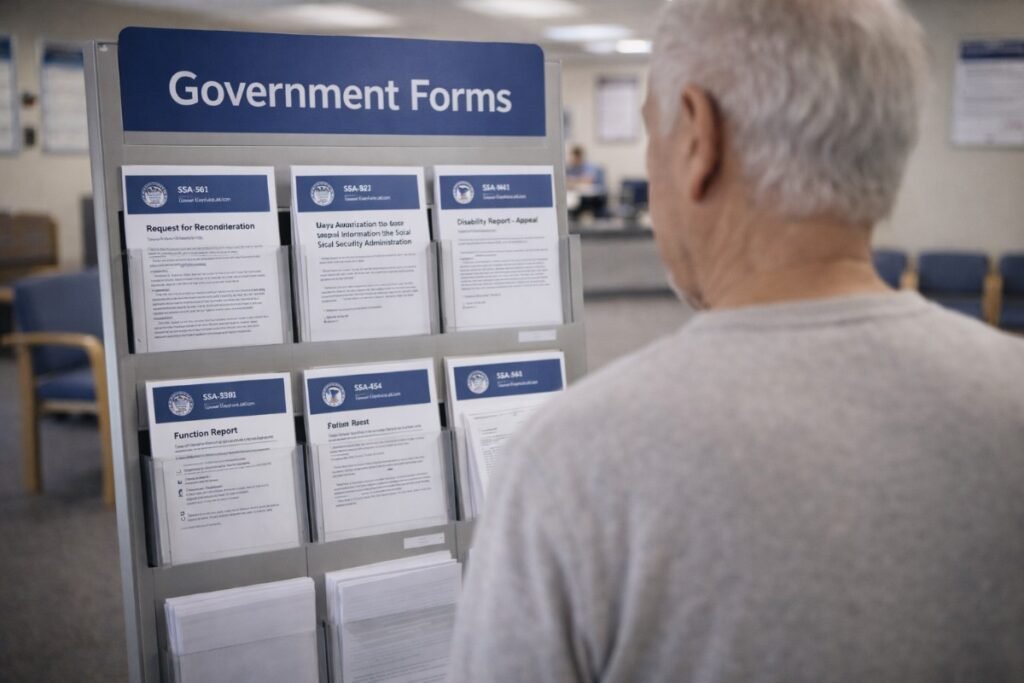
Form SSA-561: Request for Reconsideration
This is the only truly mandatory form for filing a reconsideration request. Form SSA-561 is a relatively simple document – usually two to three pages – that formally notifies Social Security that you’re appealing the initial denial.
The form asks for:
- Your identifying information (name, Social Security number, date of birth)
- Information about your claim (date of denial, claim number)
- A brief explanation of why you disagree with the denial
- Your signature and date
You can obtain Form SSA-561 in several ways:
- Download it from the Social Security website (ssa.gov)
- Pick it up at any Social Security office
- Complete it online through Social Security’s appeals portal
- Request that Social Security mail it to you
The form itself is straightforward, but accuracy matters. Make sure all identifying information matches what’s on your denial letter. Sign and date the form before submitting. If you’re filing on behalf of someone else (such as a parent filing for a child or an authorized representative filing for a claimant), additional signature requirements may apply.
Form SSA-3441: Disability Report – Appeal
While not always mandatory, Form SSA-3441 is typically requested as part of the reconsideration process. This form asks for updated information about your medical condition, treatment, and work history since the date of your initial application.
The Disability Report – Appeal includes questions about:
- Changes in your condition since you applied
- New medical treatments or providers
- New medications or therapies
- Any work activity since the initial application
- Hospitalizations or emergency room visits
- New test results or medical procedures
This form is important because it helps the reconsideration examiner understand what has changed since the initial determination. If your condition has worsened, if you’ve stopped working, or if you’ve undergone new diagnostic testing, this is where you document those changes.
Supporting Forms
In addition to the core forms, several supporting forms may be relevant depending on your specific situation:
Form SSA-827: Authorization to Disclose Information to Social Security
This form authorizes your medical providers to release your records to Social Security. If you’re submitting records from new doctors or healthcare facilities that weren’t included in your original application, you’ll need to complete a separate SSA-827 for each provider.
The form requires:
- Your identifying information
- The name and address of the medical provider
- The specific records you’re authorizing to be released
- Your signature and date
Most Social Security offices have a supply of blank SSA-827 forms, and you can also download them from ssa.gov. You’ll typically need multiple copies if you’re seeing several different doctors or specialists.
Form SSA-3380: Function Report
If requested, this form asks detailed questions about your daily activities and functional limitations. It’s designed to help Social Security understand how your condition affects your ability to work and perform basic life activities.
The Function Report asks about:
- Your typical daily routine
- Activities you can no longer do because of your condition
- Limitations in areas like sitting, standing, walking, lifting, concentrating, and remembering
- How your condition affects personal care, household chores, and social activities
This form can be valuable because it provides context that may not be apparent from medical records alone. If your doctors’ notes don’t fully capture how your condition affects your day-to-day life, the Function Report is your opportunity to explain it.
Form SSA-454: Continuing Disability Review Report
This form is typically used for continuing disability reviews rather than initial reconsiderations, but in some cases, Social Security may request it as part of a reconsideration if they need updated information about your current medical status.
Medical Source Statements or Residual Functional Capacity (RFC) Forms
These are not official Social Security forms—they’re questionnaires completed by your doctors to provide detailed opinions about your functional limitations. Many disability advocates recommend obtaining RFC forms from your treating physicians because they provide the kind of specific, detailed information about work-related limitations that Social Security needs to see.
RFC forms typically ask doctors to assess:
- How long you can sit, stand, or walk during an 8-hour workday
- How much weight you can lift or carry
- Whether you have limitations in reaching, handling, or fingering
- Whether you have environmental restrictions (avoiding heights, hazards, etc.)
- Whether you have mental limitations (concentration, memory, social interaction)
While RFC forms are not required, they can be powerful evidence if completed thoroughly and supported by the doctor’s treatment notes.
Consequences of Errors
Form-related mistakes can have serious consequences:
Missing Signatures
An unsigned form is invalid. Social Security will either reject it or send it back for signature, which costs valuable time and can jeopardize your deadline.
Incomplete Information
Leaving required fields blank can delay processing. In some cases, Social Security may return the form or contact you for clarification, which extends the timeline for your reconsideration.
Incorrect Information
Providing wrong dates, misspelled names, or incorrect Social Security numbers can cause confusion and slow the process. Always double-check information against official documents before submitting.
Missing Forms
If Social Security requests a specific form and you don’t provide it, they may issue a decision based on incomplete information, which usually results in denial.
Illegible Handwriting
If you complete forms by hand and your writing is difficult to read, the examiner may misinterpret important information. Type forms whenever possible, or write very clearly in print.
Why This Happens
Form-related problems happen for several reasons. The Social Security disability system involves a lot of paperwork, and it’s easy to miss a signature, skip a question, or complete the wrong form. Many applicants are dealing with cognitive impairments, mental health issues, or physical limitations that make managing paperwork challenging.
Additionally, the forms themselves can be confusing. They use government terminology, ask overlapping questions, and sometimes request information that applicants don’t have readily available. Without guidance, it’s easy to make mistakes.
Common Mistakes to Avoid
Don’t Leave Questions Blank
Even if a question doesn’t seem to apply to your situation, provide an answer. Write “N/A” or “Not applicable” rather than leaving it blank. Blank fields raise questions about whether you simply skipped the question or whether the information doesn’t apply.
Don’t Rush Through Forms
Take the time to read questions carefully and provide thoughtful, complete answers. Rushing increases the likelihood of errors.
Don’t Assume Forms Are Optional
If Social Security sends you a form to complete, it’s required unless they explicitly say otherwise. Complete and return all requested forms within the specified timeframe.
Don’t Submit Forms Without Reviewing Them
Before you submit, review every form to make sure it’s complete, signed, dated, and accurate. Check that you’ve answered every question and that all identifying information is correct.
Don’t Forget to Keep Copies
Make copies of all completed forms before submitting them. If questions arise later, you’ll want to know exactly what you submitted.
Deadlines and Next Steps
While the 60-day deadline applies to filing the reconsideration request itself (Form SSA-561), other forms may have different timelines. If Social Security sends you additional forms to complete after you’ve filed, they’ll typically specify a deadline—often 10 to 30 days from the date of their request.
Missing these subsequent deadlines can result in your reconsideration being decided based on incomplete information, which typically means denial.
After filing your forms:
- Keep copies of everything: Maintain a file with copies of all forms you’ve submitted.
- Follow up if requested: If Social Security asks for additional forms or information, respond promptly.
- Continue gathering evidence: While forms are important, medical evidence is usually the most critical component of your reconsideration.
Moving Forward
Forms are the procedural foundation of your reconsideration. Completing them correctly, thoroughly, and on time ensures that your case moves forward without unnecessary delays or complications.
While forms alone won’t win your case—medical evidence is far more important—mistakes or omissions on forms can create problems that weaken or delay your appeal. Take the time to get the paperwork right, and you’ll avoid one of the most common sources of reconsideration problems.
This page provides general informational content only and is not affiliated with the Social Security Administration (SSA) or any government agency.